What Is an ATS? How Applicant Tracking Systems Read Your Resume
You find a job that looks like a strong match. You have the experience. You meet most of the requirements. You update your resume, complete the application, click Submit, and then hear nothing.
No interview. No call. Sometimes, not even a rejection email. After this happens a few times, it is natural to start wondering:
Is anyone actually seeing my resume?
This is usually when people start blaming the ATS.
You have probably heard things like:
“You need to beat the ATS.”
“Your ATS score is too low.”
“If your resume is not formatted correctly, the system will reject it.”
But that is not quite how it works.
An ATS is simply part of the hiring process. If you understand what it does, how it reads your resume, and how recruiters use the information in it, you can make sure your resume is helping you. It should make it easier for people to see that you are qualified, not harder.
What Is an ATS and How Does It Work?
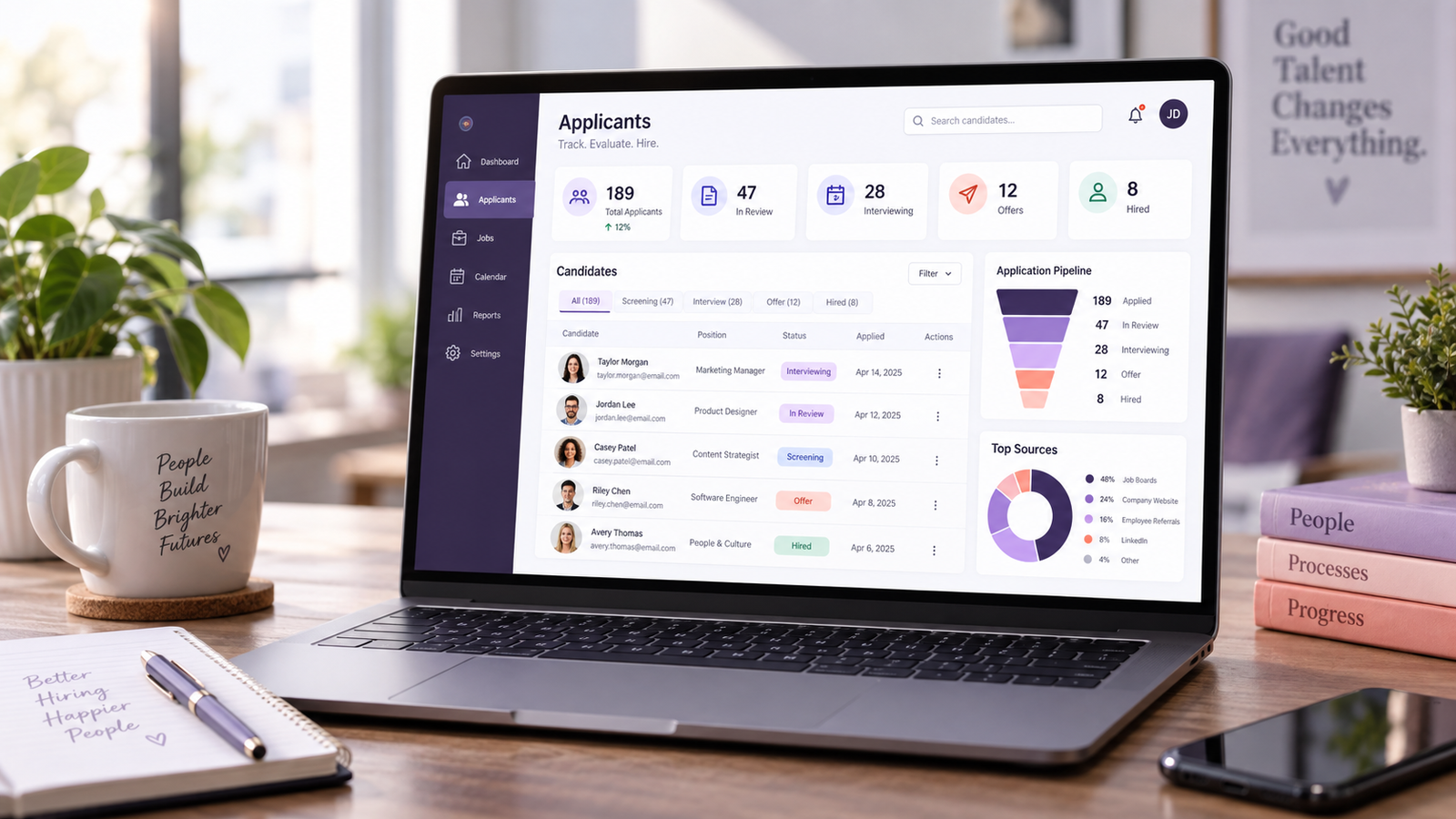
ATS stands for Applicant Tracking System.
An ATS is recruiting software employers use to collect, organize, search, track, and manage job applications throughout the hiring process.
Think about a company advertising several positions and receiving hundreds, sometimes thousands, of applications.
Recruiting teams need somewhere to manage all that information.
An applicant tracking system helps them keep applications and candidate information in one place rather than trying to manage everything manually through email, spreadsheets, and folders.
Depending on the system and how the employer has configured it, recruiters may use an ATS to:
- Collect job applications
- Store candidate information
- Track applicants through different stages of hiring
- Search candidate records
- Filter or organize applications
- Manage interviews
- Record recruiting activity
- Communicate with candidates
This is why I want you to think of an ATS primarily as a recruiting management system, not a robot whose only purpose is to reject resumes.
Oracle, for example, describes an applicant tracking system as software that allows recruiters and employers to track candidates throughout the recruiting and hiring process. Different ATS platforms can include anything from basic database functions to more advanced tools for filtering, managing, and analyzing candidates.
And there is one point that gets lost in a lot of online ATS advice:
There is no single ATS that every employer uses in exactly the same way.
Different systems have different capabilities. Employers configure their hiring processes differently. Recruiters also use the tools available to them differently.
So when someone tells you that every ATS rejects a particular resume design or that you need a specific score to get an interview, be careful.
The better goal is much simpler:
Create a resume that is clear enough for recruiting technology to process and strong enough for a recruiter to understand.
What Information Can an ATS Collect From Your Resume?
When you submit an application, an ATS may store the resume itself and extract information from it.
Depending on the system, that information may include:
- Your name and contact information
- Current and previous job titles
- Employers
- Employment dates
- Skills
- Education
- Certifications
- Professional experience
Some of that information may then become part of your candidate profile and may be searchable by the recruiting team.
That brings us to the part job seekers really need to understand.
If you are already wondering whether your own resume is easy for an ATS to read, I created a free ATS Quick Guide & Diagnostic to help you check it.
How Does an ATS Read Your Resume?

An ATS does not necessarily read your resume in the same way a person does. A recruiter can look at a page and immediately understand visual relationships. They can usually tell which text is your job title, which company you worked for, where your employment dates sit, and where one section ends and another begins. Software may first need to extract that information and turn it into structured candidate data.
A simplified version of the process may look like this:
Your Resume → ATS → Information Extraction → Candidate Profile → Recruiter Review
For example, your resume may show:
Marketing Manager
ABC Company
January 2023–Present
The system may attempt to identify:
Job Title: Marketing Manager
Employer: ABC Company
Employment Dates: January 2023–Present
It may also identify professional skills and terminology connected to your experience.
Once information has been extracted, some of it may become searchable inside the employer’s recruiting system. This is where ATS resume screening is often misunderstood.
A recruiter may not always begin by manually opening every resume and reading each application from top to bottom. Depending on the employer, the role, and the technology being used, recruiters may search or organize candidates using criteria such as skills, qualifications, job titles, certifications, location, experience, or other job-specific information.
So if the position requires Salesforce and you have used Salesforce for five years, do not make the recruiter infer that from vague wording.
Say it clearly.
If financial forecasting is part of your experience and the employer specifically asks for financial forecasting, use that recognizable terminology where it truthfully describes what you have done. Your objective is not to trick the system. It reduces the gap between what the employer is looking for and how your resume describes your relevant experience.
What Does Resume Parsing Mean?
You will hear the word parsing often when people discuss ATS resumes.
Resume parsing is the process of extracting information from your resume and turning it into data a recruiting system can organize and use.
You may have already seen this happen.
You upload your resume to an application portal and suddenly your name, education, previous employers, or job history appear automatically in fields on the application form.
That is the system trying to interpret your resume.
For example:
Senior Financial Analyst | XYZ Corporation | 2022–Present
may be interpreted as:
Job Title: Senior Financial Analyst
Employer: XYZ Corporation
Dates: 2022–Present
This is one reason structure matters.
A human may look at an unusual layout and understand it immediately. A parser may interpret that layout differently. That does not mean every visually designed resume will fail. Modern applicant tracking systems vary significantly in their capabilities. But complicated formatting can introduce unnecessary risk when a simpler layout would communicate exactly the same information.
My rule is simple:
Do not make the technology or the recruiter work harder than necessary to understand your career history.
How Do Keywords Work in an ATS Resume?
Resume keywords are probably one of the most misunderstood parts of ATS optimization.
Keywords are words and phrases connected to the skills, qualifications, tools, responsibilities, and experience relevant to a particular job.
And one of the best places to find them is sitting right in front of you:
the job description.
Where Do Resume Keywords Come From?
Suppose an employer repeatedly mentions:
- Account management
- Salesforce
- SaaS
- Customer retention
- Upselling
- CRM
- Revenue growth
Now imagine that you genuinely have experience in all of those areas, but your resume simply says:
“Helped customers and supported company growth.”
That may be true. But it tells me very little.
Compare it with:
“Managed a portfolio of B2B SaaS accounts using Salesforce, identifying upsell opportunities and implementing customer-retention strategies.”
The second version does not simply contain more keywords. It contains more useful information. That is the distinction I want you to understand.
If you have relevant experience, use the language recruiters recognize for that experience.
Why Keyword Stuffing Does Not Work
Once job seekers learn that keywords matter, some make the mistake of trying to fit as many as possible into the resume.
Please don’t.
Repeating project management fifteen times does not demonstrate fifteen times more project-management experience.
Your resume still has to make sense to the person reading it.
Relevant keywords may naturally appear in your:
- Professional summary
- Skills section
- Work experience
- Achievement statements
- Certifications
- Education
- Relevant projects
But wherever possible, connect the keyword to evidence.
Instead of simply listing:
Project Management
show what you managed.
Instead of repeatedly writing:
Sales
show what your sales work achieved.
For example:
“Increased territory revenue by 18% in 12 months by expanding enterprise accounts and improving client-renewal activity.”
Keywords help describe your relevance. Your experience helps prove it.
What Is an ATS-Friendly Resume Format?
An ATS-friendly resume does not need to be ugly. And it certainly does not need to look like something you created in 1998. It simply needs to be clear.
Use recognizable section headings such as:
- Professional Summary
- Skills
- Professional Experience
- Education
- Certifications
There is really no advantage in naming your work experience section something creative like My Career Journey. A recruiter understands Professional Experience immediately. The purpose of the section is clear.
Which Resume Elements Can Cause Problems?
Different ATS platforms handle resume formatting differently, so I would never responsibly tell you that one particular design element will fail in every system.
But I would be cautious about unnecessary use of:
- Complex text boxes
- Tables
- Decorative graphics
- Skill-rating bars
- Icons replacing important words
- Unusual multi-column layouts
- Important information placed inside headers or footers
The question I would ask is:
Is this design helping the employer understand my experience, or is it simply decoration?
A simple layout does not guarantee an interview.
It simply removes complexity that may not be adding any value.
Can an ATS Read a PDF Resume?
Many modern applicant tracking systems can process normal text-based PDF files. Microsoft Word documents are also commonly accepted.
There is no reason to turn this into another universal ATS rule.
If the employer asks for a particular file format, follow the employer’s instructions.
More importantly, make sure the file contains actual readable text.
A resume that has been scanned and saved as an image is not the same as a normal document containing selectable text.
Here is a simple test you can do yourself.
Copy the text from your completed resume and paste it into a plain-text document.
Then look at the result.
Can you still identify your employers, job titles, dates, skills, and achievements?
Does the information appear in a logical order?
If the result becomes completely chaotic, your ATS resume format may be more complicated than it needs to be.
Common ATS Myths
There is a lot of ATS advice online. Some of it is useful. Some of it makes recruiting technology sound far more mysterious — and far more powerful — than it really is.
Does Every ATS Give Your Resume a Score?
No.
There is no universal ATS score or passing percentage that applies to every employer, every applicant tracking system, and every job. Some recruiting technology may include matching, ranking, filtering, or screening functionality. Other hiring processes may rely on different tools and workflows.
So do not assume that a score from an online ATS scanner tells you whether a real employer will interview you.
Do You Need to Beat the ATS?
No.
You are not in a competition with software. Trying to find tricks to get past ATS is the wrong objective. Your objective is to communicate your genuine qualifications clearly enough for recruiting technology to process them and for a recruiter to understand them.
Do More Keywords Improve Your Chances?
Not necessarily.
Relevance matters more than repetition. Adding a keyword fifteen times does not prove that you have fifteen times more experience. A recruiter still needs context and evidence.
Does an ATS-Friendly Resume Have to Look Boring?
No.
A professional resume can be clean, attractive, and easy to read without becoming complicated. Good typography, spacing, organization, and visual hierarchy can create a polished document without relying on excessive graphics.
Can You Use the Same Resume for Every Job?
You can keep a strong master resume.
But that does not mean you should send exactly the same version to every employer. Your career history does not change from one application to the next.
The emphasis may need to.
If one position heavily emphasizes project management and another prioritizes stakeholder management, the most relevant parts of your experience should be easier to see for each job.
That is tailoring. You are not changing the truth. You are making the relevant truth easier to find.
How to Make Your Resume More ATS-Friendly
If you want to know how to make a resume ATS-friendly, start with the job description — not with an ATS score.
Read the position carefully and identify the most important:
- Skills
- Qualifications
- Responsibilities
- Tools and systems
- Certifications
- Experience requirements
- Industry terminology
Then compare those requirements with your resume. Ask yourself:
Do I genuinely have this experience?
And if you do:
Can the employer see it clearly?
This is one of the most important distinctions in resume writing.
Being qualified for a job and clearly demonstrating that you are qualified are not the same thing.
Use standard section headings. Keep your employment history organized consistently. Make your titles, employer names, dates, responsibilities, and achievements easy to understand.
Use relevant keywords naturally. And show evidence.
Compare:
“Responsible for project management.”
with:
“Managed six cross-functional implementation projects from planning through launch, coordinating schedules across sales, operations, and engineering teams.”
The second example gives me much more information.
I can see scope.
I can see responsibility.
I can see context.
Where appropriate, include measurable achievements too but only use numbers you can genuinely support. Do not invent a percentage simply because somebody told you every resume bullet needs a metric.
And remember:
An ATS-friendly resume still needs to work for a human being.
Before You Submit Another Application
If your resume is difficult for the software to interpret or does not clearly communicate the qualifications being searched for, you may be making the recruiter’s job harder before they ever properly review your experience.
ATS-Friendly Resume Checklist

Before you click Submit, check whether your resume:
- Clearly identifies the type of work you do
- Includes skills relevant to the target role
- Uses terminology that naturally aligns with the job description
- Uses straightforward section headings
- Clearly identifies your job titles and employers
- Uses consistent employment dates
- Makes important qualifications easy to find
- Uses relevant keywords in context
- Provides evidence of your achievements
- Avoids unnecessary formatting complexity
- Contains readable, selectable text
- Follows the employer’s file-format instructions
- Has been proofread carefully
- Has been tailored to the position
- Still reads naturally to a human recruiter
If several of those areas are missing, the answer may not be another attractive resume template.
The real issue may be how effectively your resume communicates your fit for the role.
Frequently Asked Questions About ATS Resumes
What Does ATS Mean?
ATS stands for Applicant Tracking System. It is recruiting software employers use to collect, organize, search, track, and manage job applications throughout the hiring process.
How Does an ATS Read My Resume?
An ATS may use resume-parsing technology to extract information such as your work history, skills, education, certifications, job titles, and employment dates. That information may then become part of a candidate record recruiters can review or search.
Why Is My Resume Not Getting Interviews?
There can be many reasons, including competition, experience requirements, hiring priorities, or the strength of other applicants.
Your resume may also fail to clearly communicate how your experience aligns with the vacancy — even when you genuinely have relevant qualifications.
So if you keep asking why my resume is not getting interviews, the answer may not be another redesign.
Sometimes the issue is alignment.
How Do I Know if My Resume Is ATS-Friendly?
An ATS-friendly resume generally uses clear headings, readable text, consistent employment information, straightforward formatting, and relevant terminology.
It should also remain easy for a human recruiter to understand.
Does an ATS Automatically Reject Resumes?
ATS platforms and employer hiring processes vary.
Some employers use screening questions, rules, filters, or other automated processes. But there is no single automatic rejection process shared by every ATS and every employer.
Can an ATS Read a PDF?
Many modern applicant tracking systems can process normal text-based PDFs.
If an employer requests a specific file type, follow those instructions.
What Keywords Should I Put in My Resume?
Start with terminology in the job description that accurately reflects skills and experience you genuinely possess.
Look for relevant tools, responsibilities, qualifications, certifications, job functions, and industry terminology.
Use those resume keywords naturally and in context.
Should I Use the Same Resume for Every Application?
Keep a comprehensive master resume if that works for you, but tailor the version you submit so that your most relevant skills and experience are easy to see for the specific position.
Can a Good Resume Guarantee I Will Get Through an ATS?
No.
No resume can guarantee an interview.
ATS optimization is about reducing avoidable barriers and communicating your qualifications clearly. Hiring decisions still depend on many other factors.
How Do I Get Past ATS Screening?
I would change the question.
Instead of asking how to get past ATS, ask:
How can I make my resume easier for both the ATS and the recruiter to understand?
Clear formatting, relevant terminology, recognizable headings, job-specific language, and evidence of your experience are much more useful than ATS tricks.
Final Thoughts
You do not need to beat an ATS.
You need to make it easier for the system — and the recruiter behind it — to understand what you bring to the job.
Keep your resume clear. Use terminology that reflects your real experience. Show evidence of what you have done. And tailor the application to the opportunity in front of you.
Your experience cannot help you if the employer cannot see it.
Resumes built for systems. Written for humans.